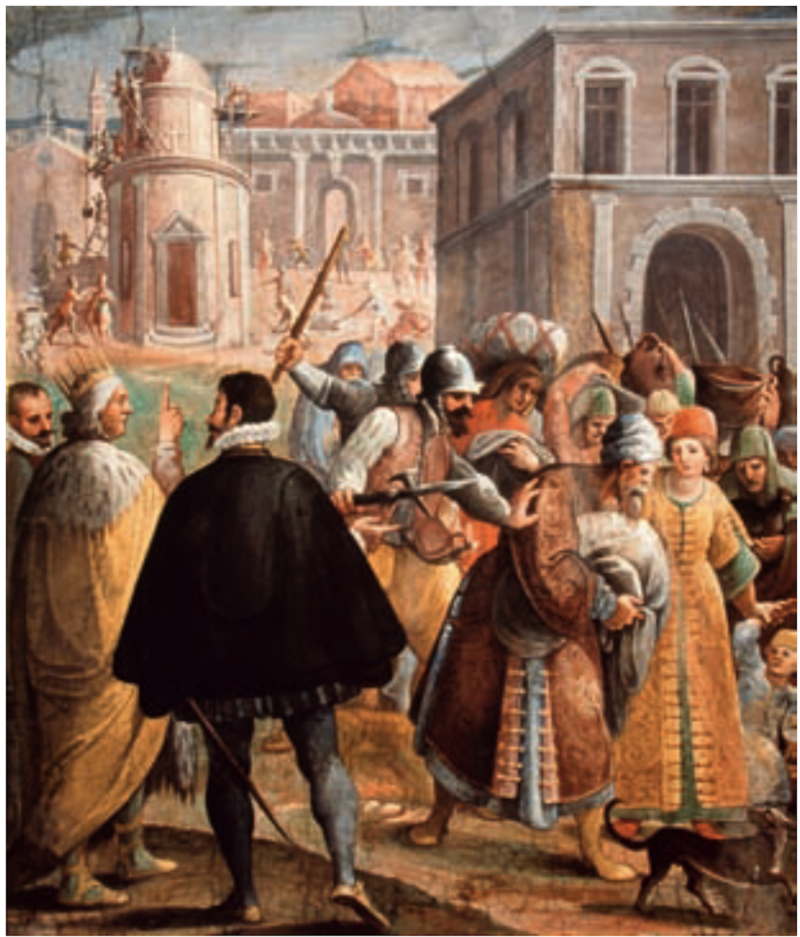
Focusing on two early modern 'sanctuary cities' (Venice and Livorno), this talk - and the book project behind it - argues that refugees were not only the victims of state violence but actively negotiated with governments, contributing to the creation of asylum and resettlement policies. Moving displaced people from the margins to the center of the stage, it does not trace just a “history from below,” solely centered on persecuted minorities and subaltern groups, but rather a larger “refugee history,” that considers both institutions and communities, and recovers the norms and practices that arose in response to forced migration.
Diego Pirillo is Professor of Italian and Affiliated Faculty in the History Department at UC Berkeley. Focusing on early modern Europe and the Atlantic world, his work strives to recover voices silenced by official narratives, including those of exiles, refugees, and persecuted minorities. He is the author of The Atlantic Republic of Letters. Knowledge and Colonialism in the Age of Franklin (University of Pennsylvania Press, 2026), and The Refugee Diplomat. Venice, England and the Reformation (Cornell University Press, 2018), awarded the 2019 MLA Scaglione Prize in Italian Studies. Recent edited volumes include Reframing Treaties in the Late Medieval and Early Modern West (Oxford University Press, 2025), and Braudel's La Méditerranée: Paradigms and Possibilities after 75 Years, special issue for Republics of Letters (2026). His new book Renaissance Refugees. Negotiating Displacement in Early Modern Italy is forthcoming with Cambridge University Press.